
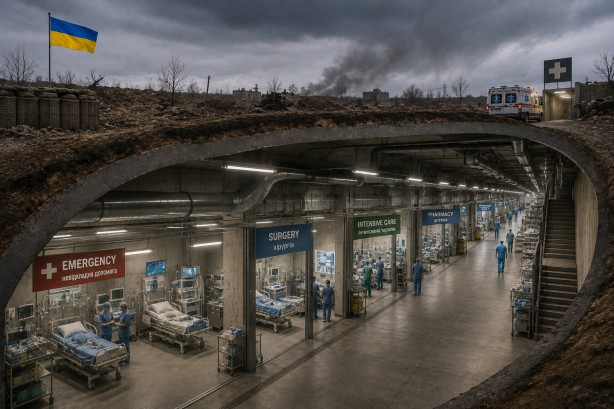
A Dutch foundation has unveiled ambitious plans to construct what it claims will be Ukraine’s largest underground hospital, strategically positioned near the front lines to deliver emergency medical care while shielding patients and staff from the threats of drone and artillery attacks. This robust facility, sprawling over 600 square meters, will be situated roughly eight meters below the surface. Its reinforced concrete design is intended to endure intense bombardments. The hospital will house six operating rooms tailored for urgent trauma interventions, such as surgeries for shrapnel wounds and blood transfusions.
The establishment is not intended to function as a standard hospital but rather as a critical stabilization center. Its primary role will be to provide immediate surgical care to severely injured soldiers before their transfer to hospitals located farther from the conflict zone. In light of security concerns, the precise location of this underground facility remains undisclosed. Construction has commenced, with the hospital slated to be operational by February 2027.
This initiative arises from a request by Ukraine’s Military Medical Service and is being executed with assistance from a Norwegian healthcare foundation. The estimated cost for the construction of this subterranean complex is €2 million, with an additional €500,000 required for medical equipment, supplies, and armored evacuation vehicles. Consequently, the total budget for the project is projected to reach €2.5 million. To date, approximately €750,000 has been raised, and efforts are underway to secure the remaining €1.75 million needed to bring the project to fruition.
According to project organizers, the increasing use of drones in combat areas has heightened the risks associated with traditional evacuation methods. This has underscored the necessity for fortified medical facilities in proximity to active battlefields. The foundation overseeing the project emphasizes the importance of such secure medical centers in ensuring that wounded soldiers receive timely and life-saving treatment, bolstering the overall medical response capability in the conflict-affected regions of Ukraine.