
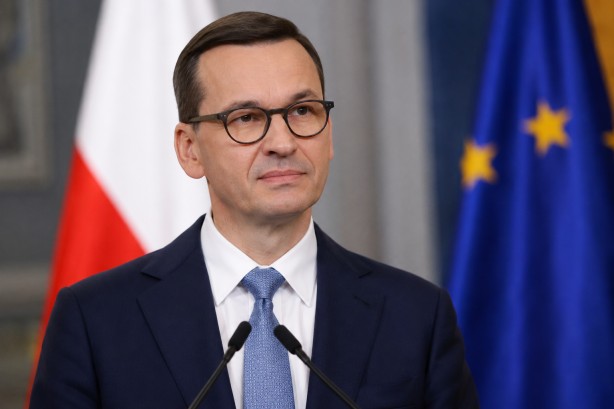
Mateusz Morawiecki, the former Prime Minister of Poland, has revealed his plans to step down as the president of the European Conservatives and Reformists (ECR) Party. However, he left the door open to remain in the role if party members express a desire for him to do so. This development arises as the ECR presidency is customarily held by the second-largest party within the alliance. Morawiecki acknowledged that his political group would no longer occupy that position, prompting his decision to consider resigning.
The announcement comes in the midst of internal disagreements within Poland’s Law and Justice (PiS) party, particularly concerning membership declarations and Morawiecki’s association, Rozwój Plus. These tensions have cast a shadow over the party’s internal dynamics, adding complexity to Morawiecki’s position within the ECR. Despite these challenges, he emphasized that his political faction still boasts the support of dozens of lawmakers and several Members of the European Parliament, underscoring their continued influence and presence in the political landscape.
Morawiecki’s tenure as ECR president began in early 2025, a position he secured with the support of Italian Prime Minister Giorgia Meloni. His leadership was seen as a significant step in strengthening ties between conservative parties in Europe, and his potential departure could have implications for the unity and direction of the ECR alliance. The party’s role in European politics, particularly in terms of conservative values and reformist agendas, has been a focal point during his presidency.
As the ECR navigates this period of transition, Morawiecki’s announcement adds a layer of uncertainty to the party’s future leadership and strategic direction. The decision on whether he will continue in his role may ultimately depend on the collective will of the party members, who are grappling with the evolving political landscape and the challenges that come with it. For now, the focus remains on how the party will address these internal issues and maintain its influence within the European Union’s political framework.