
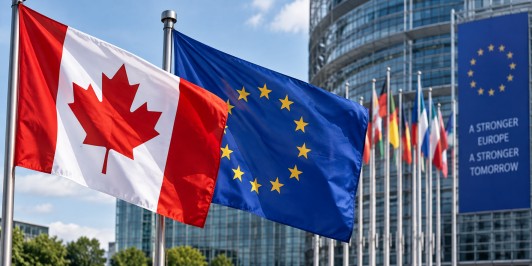
Amid escalating trade tensions with the United States, Canada is making a concerted effort to enhance its economic and strategic relationships with the European Union. Prime Minister Mark Carney has engaged in talks with leaders from France, Germany, and Italy, focusing on the possibility of drawing Canada closer to the EU. However, this initiative does not aim for full EU membership. Instead, Canadian authorities are contemplating an associate membership that would potentially grant the country improved access to the EU’s single market.
The proposed partnership emphasizes collaboration in key sectors such as energy, artificial intelligence, critical minerals, defense, technology, and infrastructure. Additionally, Canada is exploring ways to deepen ties in research, higher education, data centers, telecommunications, and satellite networks. A significant aspect of this initiative is Canada’s interest in boosting energy trade with Europe. This includes developing infrastructure that would facilitate the transport of Canadian natural gas to European markets, thereby helping to lessen European reliance on Russian energy sources.
Canada’s strategy reflects a broader objective of diversifying its economic dependencies, particularly given its current heavy reliance on the United States, which absorbs about two-thirds of Canadian exports. By seeking stronger ties with Europe, Canada aims to mitigate the risks associated with this dependence, especially at a time when relations with the U.S. are experiencing heightened tension.
While the potential for closer Canada-EU cooperation presents new economic opportunities, European leaders have approached these proposals with caution. There is an awareness that enhancing ties with Canada might exacerbate existing strains in the relationship between Washington and its European allies. Nonetheless, the dialogue continues as both Canada and the EU explore the benefits and implications of such a partnership.