
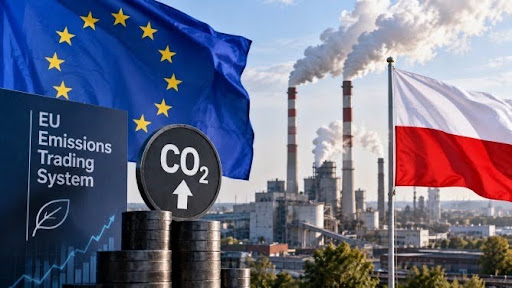
The rising expenses associated with the European Union’s Emissions Trading System (ETS) are becoming an increasing burden for Polish companies, casting doubts on the country’s industrial competitiveness. Representatives from Poland’s energy sector highlight that ETS costs can make up as much as 50% of the electricity bills for some Polish industrial consumers. This percentage stands in stark contrast to the European Union’s average, which is estimated at approximately 11%.
Poland’s officials emphasize the unique challenges the nation faces as it transitions away from one of Europe’s largest coal-dependent power systems. They argue for adjustments that would alleviate the financial impact of ETS costs while enabling continued efforts to reduce emissions. Despite these challenges, Poland has made significant strides in expanding its renewable energy capacity, including energy storage, offshore wind, and nuclear power. In July, renewable energy sources constituted 41.6% of the nation’s electricity mix, marking a milestone where renewables surpassed coal-fired generation for the first time.
In efforts to enhance energy security, Poland has also taken steps to decrease its reliance on Russian gas. This has been achieved by diversifying its energy supplies through LNG imports and developing the Baltic Pipe. The authorities maintain that the country remains committed to its energy transition goals but seeks more flexibility and time to safeguard its industrial sector and overall economic competitiveness.
Polish officials are advocating for ongoing investment in new power-generation capabilities, as well as enhancements to electricity grids, storage systems, and overall system flexibility. This strategic approach is designed to ensure that Poland can continue its energy transition journey without compromising its industrial and economic stability.